The Return of an Industrial Heavyweight: How the State Property Fund Reassembled the Mykolaiv Alumina Plant and Averted an Environmental Disaster in Southern Ukraine
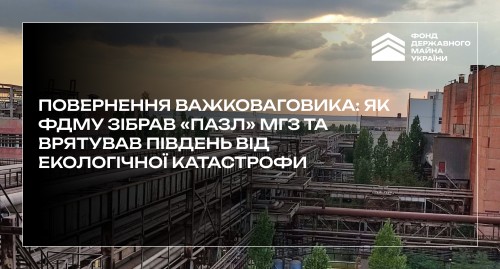
When the High Anti-Corruption Court (HACC) ruled in 2023 to confiscate the assets of sanctioned Russian oligarch Oleg Deripaska in favor of the state—including the flagship of Ukraine's non-ferrous metallurgy sector, the Mykolaiv Alumina Plant (MAP)—the government faced an unprecedented challenge.
To prevent sanctioned individuals from dismantling and selling off the plant piece by piece, the legal action at the confiscation stage was swift and uncompromising. The state seized everything separately: corporate rights, hundreds of buildings and structures, and transport assets. While this decisive approach was necessary and justified, it also created a new legal challenge—the vast industrial complex became fragmented de jure. The state inherited a "disassembled puzzle": the Mykolaiv Alumina Plant as a legal entity existed separately, the real estate separately, and the logistics assets separately.
The most serious issue lay beneath the legal formalities. As a result of this fragmentation, the plant's hazardous red mud disposal sites were left in legal limbo. Only the Mykolaiv Alumina Plant, as a legal entity, has the authority and responsibility to maintain these environmentally hazardous facilities and prevent a regional-scale environmental disaster. Yet, under the court ruling, the company had effectively lost the legal grounds to perform these critical functions.
State Property Fund Chairman Dmytro Natalukha has repeatedly emphasized in his interviews that the Fund's mission is not merely to confiscate assets from the aggressor state, but to preserve their investment attractiveness, return them to the economy, and, above all, ensure public safety.
Over the past two years, the State Property Fund's highly professional and effective Sanctioned Assets Department, working together with the management and employees of the Mykolaiv Alumina Plant, carried out an enormous and painstaking effort that remained largely invisible to the public. Every building, every structure, and virtually every bolt of this massive industrial complex had to be identified, documented, and valued. Our specialists conducted detailed inspections of more than 250 buildings and structures and 103 vehicles, assessed every individual asset, and ultimately completed this extensive process by contributing all of these assets to the authorized capital of the Mykolaiv Alumina Plant.
Today, we are proud to announce that this marathon has been successfully completed.
On June 19 and June 26, 2026, the final transfer deeds were signed, officially returning all real estate and transport assets "home"—to the authorized capital of the Mykolaiv Alumina Plant. As a result, the company's authorized capital has been successfully increased.
June represented a critical milestone. It was a strict deadline set by the Chairman of the State Property Fund. Why was this so important? The capital increase had to be reflected in the Mykolaiv Alumina Plant's financial statements for the first half of 2026, enabling the Fund to proceed to the next crucial stage—determining the starting price for privatization.
Today, we have a unified, integrated, and legally consolidated property complex. This allows us to begin forming the pool of assets that will be offered together with the Mykolaiv Alumina Plant and to fulfill the public commitment made by the Head of the State Property Fund—to bring the Mykolaiv Alumina Plant to a transparent privatization auction in 2026.
The plant is now ready for a new, responsible investor.
The State Property Fund continues to work for Ukraine's economic success, public safety, and state budget.